

In Lausanne, more than 80 childcare facilities coexist, providing families with a wide range of childcare opportunities. In the face of this diversity, parents often find themselves confronted with a dilemma: opting for a Daycare in Lausanne or turn to a subsidized structure? This question goes beyond the simple financial aspect and touches on pedagogical, organizational and emotional dimensions.
The choice of a mode of care is a major decision in family life. Between the sometimes long waiting lists of subsidized establishments and the flexibility of private structures, each option has its advantages. Your decision must take into account your child's pace, professional constraints and educational values. This article sheds light on the concrete differences between these two systems to allow you to make a choice adapted to your situation.
The fundamental differences between private and subsidized day care
Subsidised day care centres, also known as municipal crèches, receive financial support from the city and canton. They apply progressive pricing based on family income, which makes reception accessible to households with various budgets. These structures follow strict guidelines imposed by the cantonal authorities on supervision, adult-child ratios and staff training.
Private institutions operate independently, without direct public subsidies. Their funding is entirely based on parental contributions, resulting in generally higher but fixed rates, independent of family income. This financial autonomy gives them freedom in the educational organisation, schedules and services offered.
Regulatory framework and quality requirements
All Dutch day care centres, whether private or subsidized, must comply with the cantonal legislation on day care. These regulations set minimum standards for the area per child, hygiene, safety and qualification of staff. Establishments are regularly inspected for compliance with these standards.
The difference lies more in the flexibility available to private structures to go beyond these minimum requirements. Some develop specific educational projects, incorporate alternative approaches or offer additional services such as early learning of foreign languages.
The budget question: understanding tariff differentials
In a subsidized day care centre in Lausanne, the daily rate typically varies between 50 and 150 francs depending on household income and the number of children. A couple with a gross monthly income of 8000 francs will pay about 90 francs per day for a full-time reception, or about 1,800 francs per month for 20 days of custody.
| Subsidized childcare | 1500 – 2200 CHF | Family income | Progressive scale |
| Standard private guard | 2500 – 3500 CHF | Fixed tariff | Flexible packages |
| Premium private day care | 3500 – 5000 CHF | Fixed tariff | A la carte services |
Private institutions have fixed rates that typically range from 2,500 to 4000 monthly for full-time accommodation. This difference is explained by the lack of subsidies, but also by sometimes more favourable management ratios and additional benefits. For high-income families, the cost may be comparable or even lower than that of a subsidized structure calculated on their scale.
Financial aid available
Even by opting for private day care, some families can benefit from tax deductions at cantonal and federal level. Custody expenses may be deducted from taxable income up to a maximum defined by tax legislation. Some companies also offer child care contributions as part of their policy of reconciling work and family life.
Parents whose incomes are modest but who do not find a place in a subsidized structure can obtain information from the Lausanne Early Childhood Service on exceptional aid schemes. These mechanisms remain limited but in some cases partially fill the tariff gap.
Accessibility and registration deadlines: a contrasting reality
One of the main obstacles to subsidized day care is its accessibility. Waiting lists often extend over several months or even more than a year in some of Lausanne's popular neighbourhoods. Parents should ideally register from pregnancy to hope to get a place at the desired time.
Private structures generally offer more immediate availability. Their growing number and economic model allow them to adjust their capacity faster. This reactivity is a considerable asset for families facing unexpected job changes or for newcomers to Lausanne.
The flexibility of enrolment is often the decisive factor for parents who discover too late the saturation of subsidized structures. Anticipating this search several months in advance allows us to considerably expand its options.

Selection criteria in subsidized day care
Subsidized child care spaces are allocated according to specific city criteria. Priority is generally given to single-parent families, parents engaged in work or training, and special social situations. The place of residence can also play a role, with some institutions favouring the residents of the neighbourhood.
This system of prioritization, although justified by social equity objectives, may frustrate families that do not match the priority profiles. Private day-care centres, on the other hand, generally apply the first-come, first-served principle after checking the compatibility of the family project with their pedagogical approach.
Educational approaches and projects: what diversity?
The subsidized day-care centres follow a pedagogical framework defined by the cantonal authorities, ensuring a coherent educational approach focusing on the overall development of the child. They focus on socialization, autonomy and respect for individual rhythm. The proposed activities are aimed at stimulating motor skills, language, creativity and social skills.
Private institutions can develop more specific educational projects, sometimes based on recognized methods such as the Montessori approach, Reggio Emilia or Steiner-Waldorf. This specialisation attracts parents looking for a particular educational philosophy aligned with their family values. Some private structures also offer a bilingual or multilingual environment from an early age.
Activities and openness on the outside
The size and budget of the structures directly influence the range of activities proposed. Private day-care centres sometimes have greater means to organize regular outings, involve specialists (musicians, artists, psychomotricians) or develop dedicated thematic spaces.
- Weekly outings in parks and natural areas in Lausanne
- Musical and artistic awakening workshops with qualified speakers
- Introduction to a second language through progressive immersion
- Educational vegetable gardens to raise awareness of nature
- Partnerships with local cultural institutions
- Toddler-friendly aquatic activities programme
Subsidised day care centres are not left behind and also offer a rich programme, but their more constrained budget may limit the frequency of specific activities. Educational quality depends not only on the financial means but also on the commitment and creativity of the educational teams.
Hours and flexibility: adapt the guard to your professional pace
Opening hours are a determining factor for active parents. Subsidized day care generally operates from 7:00 a.m. to 6:30 p.m., with fixed time ranges for the deposit and recovery of children. This regularity is ideal for parents with stable and predictable working hours.
Private structures are often distinguished by more flexible hours. Some open at 6:30 am and close at 7:00 pm, or even later. Some institutions even offer occasional day care in the evening or on weekends, meeting the needs of parents with unusual or irregular hours. However, this adaptability has a cost, generally reflected in tariffs.
Part-time care and flexible forms
Both types of structures offer part-time formulas but with different modalities. Subsidized day care often operates on full or semi-fixed days, with year-round commitments. Changes during the year remain difficult due to high demand.
Private daycares frequently offer more flexible forms: à la carte reception, adjustable monthly packages, possibility to change the schedule with reasonable notice. This flexibility particularly attracts parents in partial telework or self-employment with varying child care needs.
Coaching ratio and group size: impact on your child
Vaud legislation imposes a minimum ratio of one adult for five children who do not yet walk, and one adult for eight children who walk. These standards apply to all structures, whether public or private. In practice, day care centres often exceed these minimums to ensure quality support.
Some private day care centres highlight more favourable child care ratios, such as one adult for four children, which allows for more individualised attention. The size of the groups also varies: the subsidized facilities usually accommodate between 40 and 80 children in several sections, while some private day care centres favour smaller numbers, creating a family atmosphere.
The importance of the physical environment
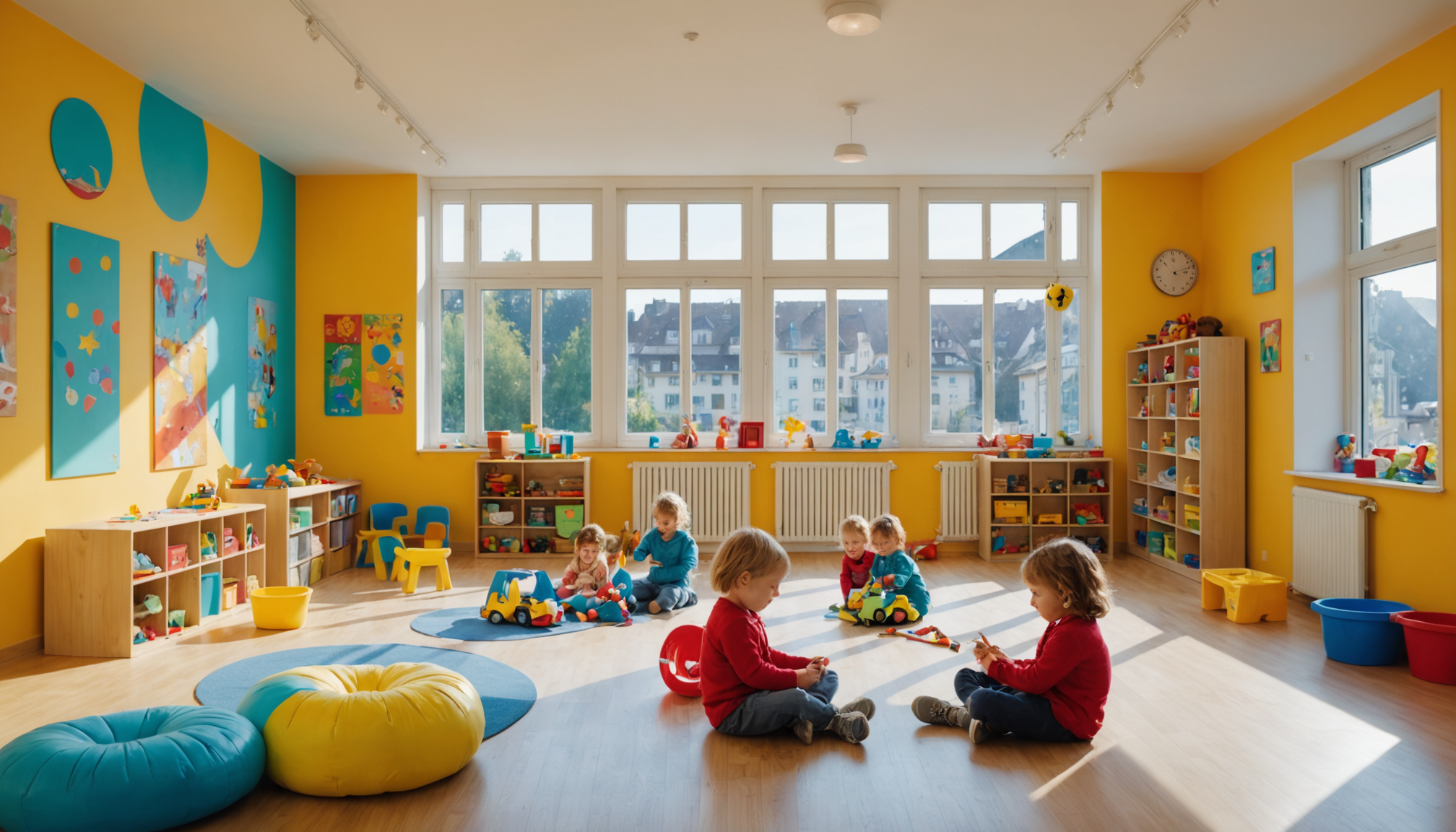
The development of spaces directly influences the well-being of children. Subsidised day care centres, often installed in dedicated buildings or municipal premises, usually have secure outdoor spaces and equipment that meet standards. Their location in residential areas facilitates access to Lao parks and green spaces.
Private structures can be found in renovated villas, furnished apartments or transformed commercial premises. The quality of infrastructure varies considerably from one establishment to another. During your visits, carefully observe the brightness, ventilation, cleanliness and organization of play areas, meals and rest.
Making the right choice: personalized decision criteria
Your decision must be based on an honest assessment of your family priorities. If the budget is a major constraint and you have the time to anticipate, subsidized day care is an economically advantageous option with a quality of reception guaranteed by public control.
If you are looking for immediate availability, extended schedules or a specific pedagogical approach, private structures deserve your attention despite their higher cost. Some families also combine the two systems, enrolling their child in a private day care centre while waiting for a subsidized place.
Practical steps for each option
For a subsidized child care place, contact the Service de la première enfance de la ville de Lausanne, which centralises applications and directs you to the available facilities. Prepare documents attesting to your employment status, income and home. Registration is usually done via an online platform with a tracking of your position on the waiting list.
For private day care, the procedure is direct to each institution. Visit several structures to compare atmospheres, meet the teams and ask all your questions. Learn about educational values, the educational project, meals offered, nap management and communication with parents. Do not hesitate to ask for references or to exchange with other families attending the structure.
Finding the balance between your constraints and your child's needs
Beyond practical and financial considerations, your choice must first and foremost meet your child's specific needs. Some toddlers thrive in lively environments with many comrades, while others prefer more intimate settings. Observe your child's temperament, adaptability and reactions during visits.
Both Lausanne private and subsidized day care centres offer safe and stimulating environments, supervised by trained professionals. The « better » option does not exist in the absolute: it depends on your family situation, your educational values, your professional constraints and your budget. Take the time of this reflection, visit several institutions and listen to your intuition during these meetings.
Whatever your final decision, remember that child care adjustment is gradually being built. A regular dialogue with the educational team, a period of familiarisation that respects your child's rhythm and your confidence in the chosen structure are the real keys to a successful transition to this new chapter of your life.


